WRITER
HELEN LEWIS


Reviews & Press
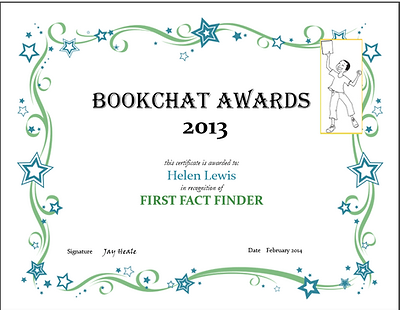
Proud of our Bookchat Award, Liezl Maree, designer, Nikki Miles, Illustrator, Wilsia Metz, publisher and me.

May 22 2013 at 10:21am
By LINDSAY ORD
by Helen Lewis (Metz Press)
Based on the national curriculum, this book is a treasure trove of information for five- to nine-year-olds. And it’s an enlightening read for adults, too.
The book covers subjects like the solar system, weather, water, plants, animals – wild, domesticated, farm, fish, birds – as well as promoting our responsibility for conserving nature. There is important information on diseases like TB and HIV/Aids, as well as bullying and stranger danger. Road safety, recycling, how to save electricity and water are relevant and important messages.
Maths, money, shapes, telling the time, flags of the world and religions, it’s all there.
This well designed book, offers bite-sized information, with illustrations and beautiful pictures, making learning fun for children – and their parents.


Review by Maxine Davies
When I took the Fact Finder home for my girls to explore, it disappeared for a few days. One evening I noticed that my husband was totally engrossed in the book he was holding – the Fact Finder.. I let him keep it with the hope of him doing this review... mmm..
Our youngest daughter eventually managed to get her hands on the Fact Finder and sat reading.. After a short while, she came running to tell me that “sharks would sink if they stopped swimming”.... that “sharks don’t have good eyesight but can smell 1 drop of blood in 100 million parts of water”... and so it goes every time one of them looks through ‘our new coffee table book’!
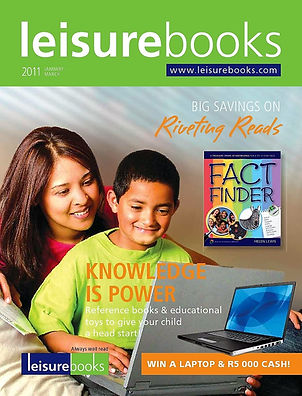
The Fact Finder is based on the South African school curriculum. It contains lots of colourful illustrations, photographs and interesting facts all put together in an uncluttered and interesting to read layout. What’s best is that it can be used by young and ‘old’.
The subjects covered in the book are : Science (human body - nature - stars & planets - basic science), Social Sciences (History & Geography), Language, Arts & Culture, Economic Management Sciences, Life Orientation and Technology.
There are even prompts in some chapters for kids and parents to do further research such as :“Go to http://wordsmith.org/anagram and have some fun typing in names or words which will be turned into anagrams”. or “Go to www.krugerpark.co.za/africa_bushbaby for fascinating information about bush babies”.
What I enjoyed about looking through the Fact Finder is that you get what you are looking for in a simpler form much quicker that what you would on the internet! Information is summarised to the ‘basic need to knows’ which makes it easier for kids to read. Don’t get me wrong here... The wealth of information on the internet is pretty much irreplaceable, but one can get soooo distracted and often taken completely off the information track you originally started on...!
So if you are looking for a quick reference book that covers a comprehensive range of subjects that are relevant to your child’s education (or to brush up on your rusty knowledge on history etc) – look no further. The Fact Finder by Helen Lewis is this book!
This book is also available in Afrikaans - Feiteboek - ’n Kennis-skatkis vir 8 tot 12-jariges

The Citizen
Friday 17 February 2012
Fact Finder - Score some points
Fact Finder is supposedly aimed at eight to 12-year-olds, but it is definitely not a bore for older kids or even adults.
29 June 2011 | SIBUSISO MKWANAZI
Fact Finder by Helen Lewis (Metz), R165,75 ISBN: 9781920268725 - Fact Finder is supposedly aimed at eight to 12-year-olds, but it is definitely not a bore for older kids or even adults.
Lewis has put together a straightforward list of facts that we should, if not know, at least be exposed to.
Because it is based on the national curriculum, the book is divided into 12 sections, covering traditional subjects such as science, geography, maths, history and economics.
As dictated by the latest curriculum, life orientation, arts and culture, language, and technology are also included.
Lewis has written other fact related titles, like The Book Of Useless Information, A Matter Of Facts, South Africa’s Top Ten Books and Factopelia, so she knows that to keep people reading, she has to keep facts short and to the point.
Her target market will use these facts to score extra marks in projects and portfolios.
Even if you do not have little ones who are in primary school, get yourself a copy so you can either impress your friends at your sophisticated work functions, or so you can flip through it quickly while Who Wants To Be A Millionaire. is on TV.
Review by Fiona de Villiers (Independent Education)
Books based on the National Curriculum Statements should always be seriously considered by librarians, teachers or parents, as a way to reinforce key learning concepts. Schools and families should most certainly add Fact Finder: A Treasure Trove of Knowledge for 8- to 12-year olds to their collections. Lovingly compiled by Helen Lewis, it’s all that a compendium should be.
Some compendiums fail to impress: Fact Finder is top of the class
Such resources can easily fail to impress – many authors’ ambitions are simply too grand, the result being a chaotic jumble of poorly laid-out facts and figures. In other cases I’ve seen, the visual design – so key in children’s books – is simply boring. In still others, material is outdated. One has to bear in mind that this age group – 8 to 12-year-olds – are the really digitally savvy learners, able to absorb, process and apply large chunks of brand new data, with the right assistance.
In the case of Fact Finder, it’s easy to see that Lewis cares both about children and what they read. She’s even taken the time to acknowledge special images contained in the book – a nice touch. A foreword by a Cape Town-based primary school Principal is another. The ‘trove’ – and what an apt description that is – is carefully organised according to the learning areas contained in the curriculum. So we begin with Science and the human body. It must have been difficult to limit each explanation – I thought Lewis had done a fine job in presenting not too little, and not too much.
All that’s expected and more
From Science, Lewis moves onto Maths – and this is really the litmus test of the book. As she does throughout, here she presents not only a variety of fascinating snippets from a wide range of local and global sources (did you know that the ancient Greeks used a clepsydra, or water clock?), but also an invigorating array of different kinds of pictures. I especially liked that fact the Lewis spent time dwelling on what she calls ‘Maths Magic’ – inviting children to explore patterns. If more teachers adopted such an approach, more children would, I believe, enjoy Maths.
The Social Sciences section is full of all the requisite facts about diversity, and then some. I loved that Lewis included, for example, a little bit about Great Zimbabwe. Too often textbooks omit information about our neighbouring countries impressive histories. Historical roots and diversity issues also form part of the section on language, one of my favourites in this book. There is no way that I can possibly share with you everything in this fantastic read, although I’m sorely tempted to do so. Unless you get your hands on Fact Finder, you’ll never know what wonders await in the Arts and Culture, Economics, Life Orientation and Technology sections. And you’ll never have the chance, if asked the question, “Are you smarter than a sixth grader?” to give the resounding yet simple answer, “Yes!”

Review in the YOU magazine
This one will keep trivia-lovers occupied for hours on end.
You know the type: those interested in facts such as the countries that drink the most tea, who scored the most goals at the Fifa World cup, the world’s best restaurants, foods with the lowest kilo joule content and the happiest country in the world (it’s not South Africa).
The best bits in the book are the fascinating facts specific to our country such as the average temperatures in South Africa’s cities, a list of Leon Schuster movies (in case you missed one) and former Idols winners.
There are also chapters on politics, business, technology and literature.
It’s a great coffee-table book and a handy reference tool if you’re looking for facts to impress pals at parties – depending on the type of friends you have, of course.
Press release from Jay Heale:
When “Bookchat” was a printed magazine, there used to be a “Books of the Year” commendation. This custom was revived to cover 2010. Here is my selected short-list from the English books submitted to the “Bookchat” website during the past year. Those concerned have received certificates.
Fiction
A WISH THIS BIG by Ingrid Mennen, illustrated by Katrin Coetzer (Tafelberg)
FINDING AUNT JOAN by Jenny Hatton, illustrated by Joan Rankin (Jacana)
MOVING HOUSE by Jenny Hatton, illustrated by Joan Rankin (Jacana)
SOLOMON’S STORY by Judy Froman (Macmillan)
STEPPING SOLO by Jayne Bauling (Maskew Miller Longman)
THE MAGIC FISH retold by Margie Orford, illustrated by Lizza Littlewort (Jacana)
Non-fiction
FACT FINDER by Helen Lewis, illustrated by Nikki Miles (Metz Press)
HELEN SUZMAN by Gillian Godsell (Maskew Miller Longman: “They Fought for Freedom”)
MY FIRST BOOK OF SOUTHERN AFRICAN OCEAN LIFE by Roberta Griffiths, illustrated by Judy Maré (Struik Nature)


Get your facts straight
Factopedia: Fascinating facts about South Africa and the world
Author: Helen Lewis
Published by Zebra Press (RANDOM HOUSE STRUIK)
Personally I am not usually one to pick up an encyclopaedia out of my own free will. Although I like doing research a book like this usually reminds me of school and how much I did not like it there. But to be honest I was quite surprised with this lovely book and have to take back everything I have ever said about this kind of book. Factopedia is the ideal gift for a brainy relative, yourself or your child and is as much interesting as it is beautiful. This is an interesting book of lists about South Africa and the world. It is crammed with fascinating facts about the universe; the earth; plants; animals; body and health; food and drink; politics; law and order; business and wealth; technology and the internet (yes, if it wasn’t for this you would have never been able to read your favourite website online every day and you also would not have had that clever microwave oven or plasma TV); literature, arts; entertainment and sport. This beautifully illustrated guide will tell you more about the highest, the lowest, the oldest, the largest, the richest, the longest, the brightest, the hardest, the most frequent, the highest scoring, the best-selling and the most expensive of just about everything under the sun. Find out more about the new dwarf planets; the world’s newest- and oldest- countries; the richest people in South Africa and lots more. Relax on your brand new sofa and find out why Pluto is no longer a planet; what the happiest country in the world is and who has scored the most tries in the FIFA World Cup by reading this lovely book!

